
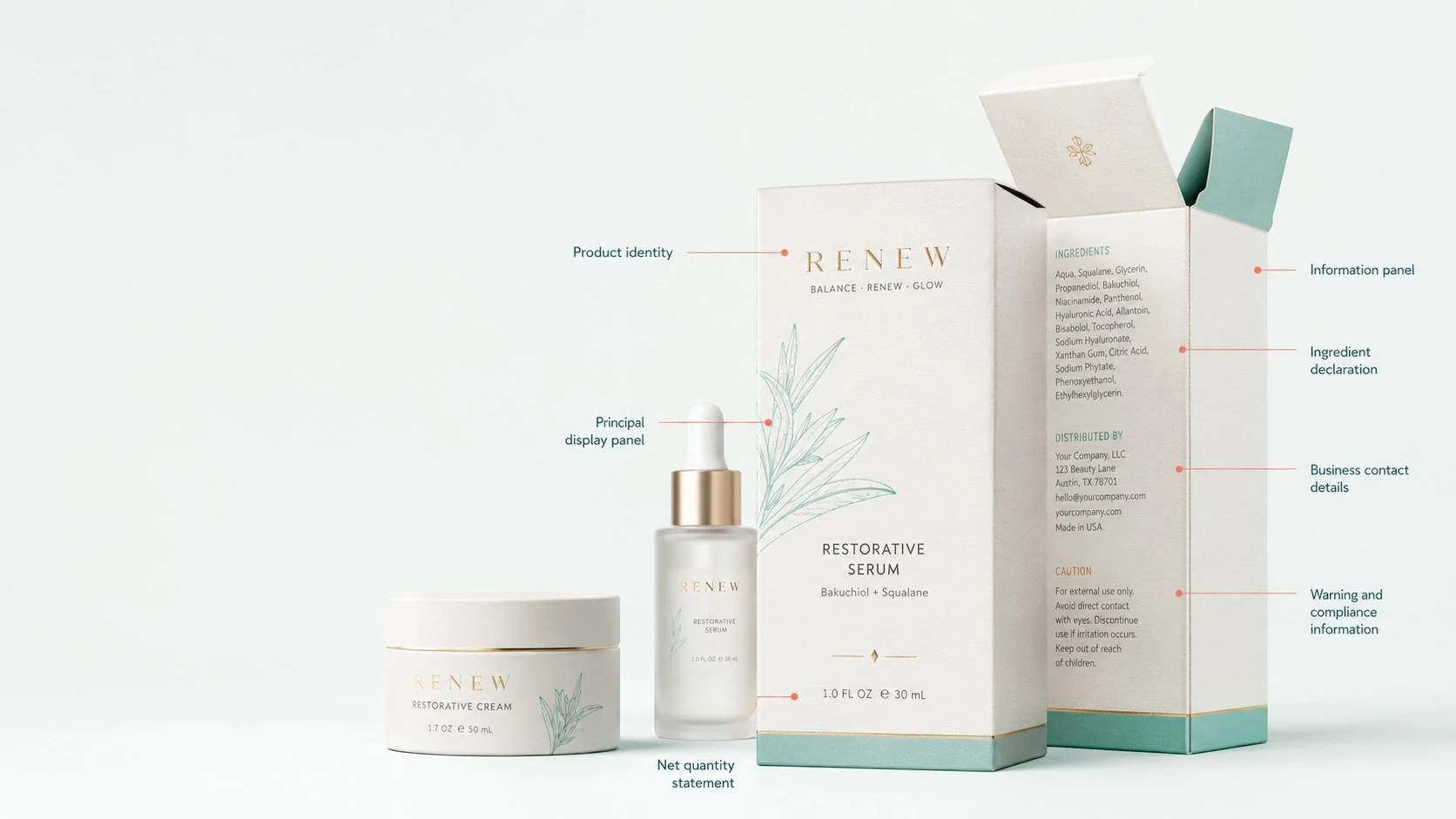
Before a folding carton, label, or outer box goes to print, every beauty brand needs a clear plan for required product information. This practical guide translates cosmetic packaging labeling requirements into an easier artwork, panel-layout, and proofing process for U.S. brands.
General information only: This article is not legal advice. Requirements can vary by product classification, claims, package format, sales channel, and state. The responsible company should obtain qualified regulatory or legal review before printing or selling a cosmetic product.
Plan compliance before decoration
Reserve room for required statements before finalizing colors, finishes, windows, embossing, or marketing copy.
Identity and quantity
The principal display panel normally communicates what the product is and how much it contains.
Details and disclosures
The information panel commonly carries ingredients, business details, warnings, and other required information.
Which U.S. Cosmetic Labeling Rules Apply?
The phrase FDA cosmetic labeling requirements refers to several federal laws and regulations that work together. Brands should identify the product’s intended use, package structure, required statements, and current claims before approving artwork.
The FDA directs cosmetic businesses to regulations in Title 21 of the Code of Federal Regulations, including Parts 701 and 740. MoCRA also introduced newer obligations affecting label planning, such as providing a domestic address, domestic phone number, or electronic contact information through which the responsible person can receive adverse-event reports.
FDA Regulation Does Not Mean FDA Pre-Approval
Ordinary cosmetic labels are not generally approved by the FDA before sale. The manufacturer, packer, distributor, importer, or other responsible party remains accountable for correct labeling. A cosmetic package should not state “FDA Approved” unless a valid and specific legal basis genuinely applies.
Understand the Packaging Layers and Display Panels
Cosmetics frequently use more than one packaging component. A serum may have a bottle, a fitted insert, and a printed folding carton. A moisturizer may use a jar inside an outer retail box. Define every layer before assigning copy.

Immediate Container
The bottle, jar, tube, compact, or pouch that directly holds the cosmetic product.
Outer Retail Carton
The box or wrapper consumers see around the immediate container at the point of sale.
Principal Display Panel
The package surface most likely to be displayed or examined under normal retail conditions.
Information Panel
A side, back, or other suitable panel used for required details that must remain prominent and readable.
Cosmetic Packaging Labeling Requirements: 10 Items to Review
Use this beauty product labeling checklist before the dieline, artwork, finishes, and print proof are approved.
Confirm Product Classification
Determine whether the intended use is cosmetic only or whether the claims may also cause the product to be regulated as a drug.
State the Product Identity
Clearly tell buyers what the product is, such as facial moisturizer, lip gloss, cleansing balm, or body lotion.
Add the Net Quantity Statement
Show the amount of product using the appropriate weight, fluid measure, count, or permitted combination in the required position and size.
Identify the Responsible Business
Include the required business name and address, with qualifying wording such as “Distributed by” when applicable.
Provide Contact Information
Include an appropriate domestic address, phone number, or electronic contact method for receiving adverse-event reports.
Prepare the Ingredient Declaration
Use the finalized formula and appropriate ingredient names, generally in descending order of predominance subject to applicable exceptions.
Add Warnings and Material Facts
Reserve enough room for required cautions, safe-use directions, and important information that affects consumer use.
Review Country-of-Origin Marking
Imported products generally require correct English country-of-origin marking in addition to applicable cosmetic information.
Check Readability
Verify contrast, type size, spacing, language, folds, glue areas, and any finishing process that could reduce legibility.
Approve the Final Proof
Review the complete folded package for copy accuracy, units, claims, contact details, barcode clearance, and dieline alignment.
Principal Display Panel vs. Information Panel
Good cosmetic box label requirements begin with assigning the right information to the right package surface.
| Packaging Area | Typical Information | Design and Proofing Priority |
|---|---|---|
| Principal display panel | Product identity and net quantity statement. | Keep the front easy to understand and protect the area needed for the quantity declaration. |
| Information panel | Business details, ingredient declaration, warnings, directions, and other required information. | Use strong contrast, readable type, and uninterrupted printable space. |
| Responsible-person contact area | Domestic address, domestic phone number, or eligible electronic contact information. | Do not place it under a seam, label, closure, insert, or difficult-to-read finish. |
| Immediate container | Requirements depend on the product and the complete packaging system. | Do not assume the outer box replaces every statement needed on the inner container. |
How to Plan Outer Carton Labeling for a Small Cosmetic Box
Small folding cartons need a disciplined information hierarchy. Branding should be built around the approved content—not the other way around.


Product identity
Brand, product name, function, and net quantity in a clear visual hierarchy.
Ingredients and company details
Ingredient list, business information, contact route, and relevant directions.
Warnings and supporting copy
Warnings, material facts, barcode, batch area, and approved marketing information.
Reserve Required Copy Before Decorative Artwork
Assign the front, side, and back panels before applying foil, embossing, windows, heavy textures, or dark background fields. Required information should remain clear after the carton is folded, glued, sealed, and stocked.
Protect Safe Areas Around Folds and Closures
Keep important copy away from cut lines, crease lines, glue flaps, dust flaps, locking tabs, windows, and areas that may be covered by a retail sticker or tamper seal.
Use Finishes Without Sacrificing Legibility
Foil stamping, spot UV, embossing, and soft-touch lamination can improve shelf presentation, but they should not sit behind ingredients, warnings, or small legal copy where reflection or texture may reduce readability.
Plan Inserts and Ecommerce Protection Separately
A fitted custom box insert can support a bottle, jar, or set in the intended orientation. Brands selling online should also decide whether the retail carton needs separate ecommerce packaging for transit protection.
Packaging Planning Tip
Before ordering custom cosmetic packaging for a beauty product, prepare the exact container dimensions and a draft of the required copy. Cartor can then recommend a structure with enough usable space for branding and approved information.
Verify Type-Size and Placement Rules
FDA rules include specific requirements for prominence, type size, and placement. Ingredient lettering is generally at least 1/16 inch high, with a smaller provision for certain packages with limited labeling surface. Net quantity type size depends on the PDP area. Confirm the exact rule for the final package instead of relying on a visual estimate.
Review Cosmetic Claims Before Printing the Box
A label must be truthful and not misleading. Claims can also affect whether the product is regulated only as a cosmetic or as both a cosmetic and a drug.
| Marketing Direction | Cosmetic-Style Framing | Needs Careful Drug or Legal Review |
|---|---|---|
| Moisture | “Helps skin feel moisturized” | “Repairs damaged skin tissue” |
| Appearance | “Reduces the appearance of dry-looking skin” | “Treats eczema” |
| Cleansing | “Cleanses excess oil and impurities” | “Cures acne” |
Examples Are Not Automatic Legal Approval
Final classification depends on the complete wording, formula, intended use, directions, website copy, advertising, and consumer understanding. Have claims reviewed before the final packaging proof is released.
A Professional Artwork Proofing Workflow
Separate regulatory review from print-production review. Both matter, but they answer different questions.
Finalize formula and ingredient names
Use the approved production formula, not an early sample or marketing draft.
Review classification and claims
Confirm intended use and remove or revise wording that requires a different regulatory pathway.
Map content to package panels
Assign the PDP, information panel, warnings, responsible-person contact route, barcode, and optional copy.
Confirm the physical product dimensions
Include insert clearance, orientation, closures, and realistic tolerances in the approved dieline.
Build on the approved dieline
Keep copy inside safe areas and away from folds, cuts, windows, and glue zones.
Review both flat and folded views
Check every visible panel, reading order, closure, barcode area, and finish after assembly.
Complete regulatory and print approvals
Obtain the responsible compliance approval and a separate production-quality approval.
Archive the final revision
Record the approved version and date used for each production run or product batch.
Cartor’s custom packaging workflow supports structure selection, dieline preparation, artwork positioning, proofing, and production. Final cosmetic compliance remains the responsibility of the brand and its qualified reviewer.
What to Send With a Custom Packaging Quote Request
Providing complete information helps the packaging team recommend a suitable structure, printable area, material, and production route.
- Product dimensions
- Product weight
- Quantity per box
- Preferred box style
- Insert requirements
- Product orientation
- Preferred material
- Printing requirements
- Finish or coating
- Total order quantity
- Delivery location
- Artwork and copy status
Related Cosmetic Packaging Resources
Explore relevant box structures and product-specific packaging options after the approved labeling copy and product dimensions are ready.
Custom Cosmetic Packaging Boxes
Review folding carton and premium packaging options for skincare, makeup, and beauty products.
View packaging options →
Custom Cream Boxes
Explore packaging for moisturizers, facial creams, skincare jars, and cosmetic treatment products.
Explore cream boxes →
Custom Lipstick Boxes
Review compact box styles, finishing options, and retail presentation for lipstick products.
Explore lipstick boxes →Frequently Asked Questions
Does the FDA approve cosmetic labels before printing?
No. Ordinary cosmetic labels are not generally pre-approved by the FDA. The responsible business must ensure the label is accurate, compliant, and not misleading.
What belongs on the principal display panel?
The PDP generally carries a clear product identity and an accurate net quantity statement, subject to applicable placement and type-size requirements.
Where should cosmetic ingredients appear?
Retail cosmetic ingredients are generally placed on an information panel where consumers can find and read them at purchase. Applicable naming and order rules must be followed.
Does an outer cosmetic box need the same information as the bottle or jar?
Not always. Requirements may apply differently to the immediate container and outer package. Review the complete packaging system rather than assuming one component replaces the other.
Do cosmetics require an expiration date in the United States?
Federal cosmetic law generally does not require an expiration date for ordinary cosmetics, but companies remain responsible for product safety. Product type, claims, retailer policies, or state rules may add other considerations.
What contact information is required under MoCRA?
The label must provide a domestic address, domestic phone number, or eligible electronic contact information through which the responsible person can receive adverse-event reports.
Can a cosmetic package say “FDA Approved”?
Ordinary cosmetics are not generally FDA-approved before sale, so that wording can be misleading. Any FDA-related statement should receive qualified regulatory review.
Can Cartor approve the legal compliance of a cosmetic label?
Cartor can help with box structure, dimensions, printable panels, dielines, artwork positioning, and production proofing. Final legal and regulatory approval belongs to the brand and its qualified reviewer.
Official Sources for Final Verification
- FDA Summary of Cosmetics Labeling Requirements
- FDA Cosmetics Labeling Regulations
- FDA Cosmetic Ingredient Names
- 21 U.S.C. § 364e — Cosmetic Labeling
Regulations and agency guidance can change. Review the article periodically and verify current requirements before production.
Plan the Packaging Before You Release the Artwork
Cosmetic packaging labeling requirements are easier to manage when approved copy, box structure, dieline, panel space, and print production are planned together. Cartor can help create a custom paperboard package around your product dimensions, presentation goals, and approved information layout.